


Jeff Schmid
By Jeff Schmid, CRCM
Want to know the best phrase I’ve heard in my 40-year banking career?
“Be careful of what you ask for, because you just might get it.”
Well, on November 7, 2025, we got it — banks of all sizes got relief from regulatory exams. It came in the form of the FDIC Financial Institution Letter (FIL)-52-2025 that extended the period of compliance exams and Community Reinvestment Act (CRA) evaluations from three years to a five-year cadence. While that may sound like relief, only time will tell.
Over the last decade, community banks have been gravitating toward risk-based management concepts, and this new pattern by the FDIC follows suit with a risk-focused supervisory approach. Smaller banks with lower compliance risk profiles will now see combined compliance and CRA examinations between 66-78 months from the previous exam, while larger banks will benefit from 54-66 months. Lower risk is defined in the FIL as banks with a Consumer Compliance Rating of “1” or “2” and a CRA rating of “Outstanding” or “Satisfactory”. For approximately 116 state-chartered banks in Wisconsin, this change may sound like relief, but when we analyze the overall impact, we start to see a much different picture.
Prior to this modernization, banks of all sizes benefited from the most knowledgeable professionals in the banking industry. While we may not have always agreed with the examiner’s findings, they left our banks stronger and more reputable. Inherently, professional relationships were forged with experienced examiners that guided us through the maze of complex, and often confusing, regulations. With the extension of examination cycles, those relationships will certainly change, if not fade.
For banks with a current Compliance Management System (CMS) rating of “2” or a CRA rating of “Satisfactory”, the chance to demonstrate improved efforts to the Board, or enhance the
community image is now significantly delayed. Report cards that were once timely will now have to wait. Nothing is more frustrating to a compliance officer than not knowing how well the compliance program is working. And think about those systemic issues or patterns of non-compliance that magically appear during an exam. Before this cycle change, a look back period for significant violations went all the way back to the prior exam. What sort of ramifications will now exist if a bank must look back for more than five years? The consequences could be significant.
Finally, there is increased cost and quality assurance to consider — one of the pillars of compliance management is the function of audit. Bank management should expect the cycle of audits to be
more frequent, and most likely will come with increased costs. Due to the delayed time between exams, there will be greater reliance by examiners on independent compliance audits, so the thoroughness by audit professionals will be extremely important. Management will need to determine who will serve them best.
The list of things to consider with the new exam approach doesn’t end here. How we navigate through the change will not necessarily be easy, as we will not know for years if we have been successful in carrying out our CMS program. While we asked for relief, we got more than we bargained for.
To learn how these changes impact your bank, or how our ShareFI services can help you through the next compliance exam, contact Jeff Schmid by email jschmid@fipco.com or call 608-441-1220.
Schmid is the FIPCO senior vice president of compliance and management consulting services.
For more information about FIPCO forms, software, or other products, visit fipco.com, call 800-723-3498, or email fipcosales@fipco.com.
FIPCO is a WBA Gold Associate Member.


Tyler Foti
By Tyler Foti, WBA director – government relations
Amplify your connections that shape the banking industry by hosting one of WBA’s Take Your Legislator to Work Day (TYLTWD), a simple, yet powerful opportunity to engage directly with elected officials and advocate for Wisconsin’s banking industry.
At its heart, TYLTWD is about meaningful conversation. Participating banks host their legislators for a visit focused on three key objectives: building stronger relationships with elected officials, sharing real-world insights from your local marketplace, and discussing state and federal issues that impact your bank and customers.
By bringing legislators into your bank, you give them a firsthand look at the critical role financial institutions play in supporting economic growth and community development. These personal connections help policymakers better understand how their decisions affect Wisconsin businesses and families.
Getting involved is easy. The WBA government relations team coordinates all scheduling and logistics, and can even attend the meeting with you to help guide the discussion. This ensures your experience is seamless, productive, and impactful.
TYLTWD is one of the most effective grassroots advocacy tools available. It’s your opportunity to amplify your voice, highlight your community impact, and help shape the policies that matter most. Another way to amplify support of the industry’s advocacy efforts is to attend WBA’s third annual Milford Hills Outing. This premier event supports Wisbankpac while bringing bankers together for an afternoon of connection and camaraderie.
Taking place on Wednesday, September 16, this exciting outing offers something for everyone, whether you’re an experienced shooter or simply looking to network with peers.
Participants can register as individuals or form a foursome, with a variety of sponsorship opportunities available.
Attendees are encouraged to contribute $100 or more to Wisbankpac, helping ensure the banking industry continues to have a strong and effective voice in Wisconsin’s legislative landscape. More than just a day at the range, the Milford Hills Outing is an investment in relationships across the industry and with the advocacy efforts that support it.
Register your spot, gather your team, and join us for a memorable day that makes a lasting impact.
Interested in hosting a TYLTWD or want to learn more about contributing to Wisbankpac? Contact Tyler Foti, WBA director – government relations, at tfoti@wisbank.com.

Daryll Lund
By Daryll Lund, WBA-EBC president
As banks around Wisconsin begin planning their 2027 budgets, now is the perfect time to evaluate one of the most important investments you can make in your workforce: employee benefits. A strong benefits package does more than support your bottom line, it shows employees that you value their health, well-being, and financial security. That’s where WBA’s subsidiary, the WBA Employee Benefits Corporation (WBA-EBC) can help.
WBA-EBC works with member banks to provide comprehensive, high-quality benefit solutions, including medical, dental, vision, prescription coverage, life insurance, and disability protection. Through the combined purchasing power of Wisconsin’s banking community, your bank can offer premium-level benefits that help attract and retain the people who help make your bank great.
What truly sets WBA-EBC apart from others is its understanding of the challenges banks face today when it comes to hiring and keeping great talent. The team is focused on delivering practical solutions, personalized support, and responsive service every step of the way. From enrollment and billing assistance to an easy-to-use online portal, managing benefits becomes simpler and more efficient.
One standout offering is WBA-EBC’s Association Health Plan, serviced by UnitedHealthcare (UHC), which allows employees and their covered spouses to earn up to $1,000 each through UHC Rewards for participating in healthy activities. Whether it’s tracking daily steps, completing a wellness assessment, or scheduling an annual checkup, participants can earn incentives at no additional cost through the UHC plan.
It’s a win-win: employees are encouraged to prioritize their health while being rewarded for doing so, and your bank reinforces a meaningful commitment to your team’s overall well-being.
WBA-EBC also partners with Lincoln Financial Group to provide life and disability insurance options that include valuable added benefits such as Travel Connect and Life Keys (included with life insurance), and employee assistance programs (included with long-term disability).
Delta Dental of Wisconsin and WBA-EBC have partnered together for the past 20 years to offer important dental benefits. Delta Dental is known for innovative high-value plan designs that offers WBA members benefit options that are otherwise only available to the state’s largest employers.
If you’re looking to strengthen your benefits offerings and show employees that their well-being truly matters, WBA-EBC can help.
To learn more about the options available, reach out to Jeff Wagner, vice president of WBA-EBC at jwagner@wisbank.com or 608-279-8148.

Wisconsin bankers are the definition of “community advocates” in all that they do every day to improve their local economy through bank products and services, as well as through generous philanthropy of time and money. The “Community Advocate Spotlight” feature shares and celebrates the diverse backgrounds, experiences, perspectives, and innovation of some of the extraordinary bankers in the state.
The following is a brief interview between WBA President and CEO Rose Oswald Poels and Dan Ravenscroft, president & CEO of Royal Bank.

Rose Oswald Poels
Rose: How did you first get into the banking industry?
Dan: Banking is practically in my blood. I say that somewhat jokingly, but there may be some truth to it. I come from a long line of bankers, with the most influential being my mom. She worked at our local community bank, and through her, I had a front-row seat to what community banking is all about. Some of my earliest memories involve representing the bank alongside her. From walking in community parades, volunteering at local events, and seeing firsthand the relationships the bank built within the community. Those experiences showed me that community banking is about much more than financial services; it’s about being present, building trust, and making a positive impact where you live and work.
My own banking journey started when I was 12 years old, mowing the lawn for my hometown bank. You could say that was my first foot in the door. Later, I joined Royal Bank as a customer service representative, which further sparked my interest in the industry. I attended the University of Wisconsin–Eau Claire and earned a degree in finance, knowing I wanted to combine my education with the experiences that shaped me growing up.
Beyond my connection to community banking, I’ve always had a natural affinity for numbers and enjoy solving problems. Banking provides the perfect opportunity to bring those interests together with my personal values of investing in and supporting local communities. Following in my mother’s footsteps and pursuing a career in community banking felt like a natural fit. It allowed me to combine my passion for people, community involvement, and problem-solving into meaningful work. It’s a decision I’ve never regretted.

Dan Ravenscroft
What is your favorite aspect of your role at the bank?
One of my favorite aspects of being a community banker is seeing the impact we make reflected throughout the communities we serve. Whether it’s our logo on a sponsorship banner at a local event, community members proudly wearing our apparel, or our employees volunteering and actively participating in their communities, those visible reminders represent something much deeper. They reflect the relationships we’ve built, the trust we’ve earned, and our ongoing commitment to supporting the people and places we call home.
I enjoy the challenge of bringing together people, ideas, and resources to solve complex problems and find the best path forward. Every day presents opportunities to think strategically, support our team, and help position the organization for long-term success. What makes that especially meaningful is knowing that our work extends beyond the walls of the bank. Community banks play a vital role as trusted partners and pillars within our communities. By keeping capital local and reinvesting in local businesses, farms, families, and community initiatives, we help strengthen the local economy and contribute to the long-term vitality of our communities. Being part of that work, and seeing the difference it makes, is incredibly rewarding.
What do you wish the general public understood about the banking industry?
While most people think of banks as a place to deposit money or obtain a loan, community banking is much more than that. In many ways, community banks serve as the economic
engines for the communities we serve.
One of the most important roles banks play is how we reinvest in the places we call home. Deposits made by local customers are reinvested back into the community through loans that help families purchase homes, entrepreneurs start and grow businesses, farmers acquire land and equipment, and local governments fund infrastructure improvements and community projects. That cycle of local deposits fueling local investment is what helps communities grow and thrive.
Banking is also a highly complex industry that operates largely behind the scenes. Every day, banks are managing risk, protecting customers, safeguarding financial assets, navigating regulations, and ensuring capital is available to support economic growth. While much of that work isn’t visible, it has a direct impact on the opportunities available to individuals, businesses, and communities.
At its core, community banking is about helping people achieve their goals and strengthening the places we call home. When local businesses succeed, families purchase homes, farms expand, and communities invest in their future, community banks are often part of making those opportunities possible.
Where do you believe the industry’s greatest challenges are in the next three to five years?
Over the next three to five years, I believe the banking industry’s greatest challenges will center around fraud, cybersecurity, and keeping pace with rapidly evolving technology. Fraudsters are becoming increasingly sophisticated, and advances in artificial intelligence (AI) are giving bad actors new tools to create convincing scams, launch cyberattacks, and exploit vulnerabilities at a
scale we haven’t seen before.
At the same time, AI will be one of the most valuable tools available to financial institutions. It presents both a difficult challenge and is a necessary asset. Banks will need to become true digital warriors, using technology and AI-driven solutions to detect threats, strengthen cybersecurity, and protect customer information while staying one step ahead of emerging risks.
Beyond security, AI and automation will also help banks improve efficiency by streamlining routine tasks and allowing employees to focus more of their time on serving customers and building relationships. The institutions that will thrive are those that can successfully balance innovation with security, embracing new technology while maintaining the trust and personal relationships that have always been at the heart of community banking.
Please describe your current role at your bank and share with us one of your more rewarding experiences (e.g., A time you had to go above and beyond to help a customer, a memorable customer interaction, stepping in to help the local community after a disaster, or something more personal, etc.).
This year, I’m proud to celebrate 30 years with the bank. Over the course of my career, I’ve had the opportunity to serve in a variety of roles, each providing valuable experiences and a deeper understanding of our customers, employees, and communities. Today, I have the privilege of serving as president and CEO, where I work alongside an exceptional team to continue building on the strong relationships and community-focused values that define our organization.
One of the most rewarding experiences of my career came when several of the communities we serve were impacted by record-breaking flooding. The devastation was heartbreaking. Families were displaced from their homes, businesses were forced to close their doors, and many people lost belongings they had spent a lifetime accumulating. At the same time, first responders and community volunteers worked tirelessly to help those affected and begin the long road to recovery.
What stands out most to me is how our employees stepped up without hesitation to support those communities. Our team rolled up their sleeves and helped with cleanup and rebuilding efforts, provided meals to those affected, supported first responders, and looked for every opportunity to help meet immediate needs. It was inspiring to see so many people
come together with a shared commitment to helping our neighbors recover and rebuild.
While community banks are often known for helping people achieve their financial goals, moments like these remind me that our role extends far beyond banking. We are part of the fabric of the communities we serve. Seeing our employees, customers, and neighbors unite during such a difficult time reinforced what community banking is truly about which is people helping people. Knowing that we were able to make a meaningful difference in the lives of those affected and help our communities begin to rebuild is something I will always be proud of
By Heather MacKinnon, WBA executive vice president and general counsel
The start of WBA’s new fiscal year is an ideal time to spotlight the many opportunities available from WBA for both new and experienced bankers to grow professionally and expand your networks.
On June 10, 2026, Joe Peikert, CEO of Wolf River Community Bank, Hortonville, was installed as Chair of WBA’s Board of Directors. Centered on the theme amplify, Peikert encouraged members to stay connected and invested in the industry’s success. As the banking landscape evolves, WBA and our members play a critical role in shaping a stronger future. WBA remains a trusted partner, providing resources to help members navigate both challenges and opportunities.
Become a WBA Advocacy Officer. Attend WBA’s Capitol Day or a Washington, D.C. advocacy trip. Amplify your voice by sharing real-life examples with lawmakers about how their decisions affect your bank, your customers, and your communities.
Attend a WBA event. WBA hosts more than 82 conferences, schools, and educational programs. These events connect bankers with industry experts, practical resources, and each other.
Connect with other bankers. WBA offers specialized opportunities, leadership development programs, and an online portal creating spaces to exchange ideas and learn from one another. These relationships strengthen individual institutions while building a more connected banking community.
Whether you are attending a conference, mentoring a colleague, or advocating for your bank, your engagement strengthens WBA and helps amplify our collective voices.

WBA releases results of Bank CEO Economic Conditions Survey
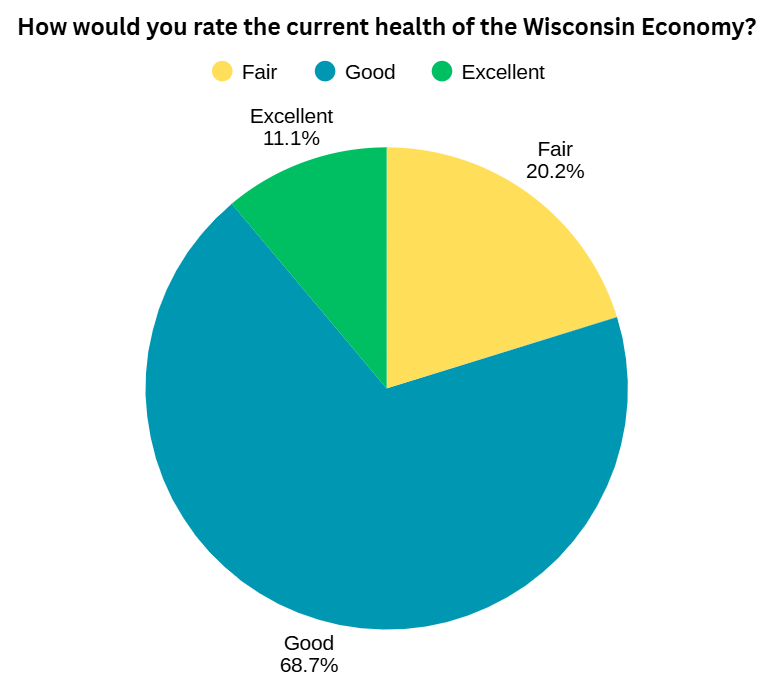
The results of the latest Wisconsin Bankers Association’s biannual Economic Conditions Survey of Wisconsin bank CEOs reflect 68% of respondents rated Wisconsin’s current economic health as “good.” Sixty-one percent of respondents expect Wisconsin’s economy to stay about the same over the next six months, a figure similar to the sentiment captured in the previous survey (55%) conducted in end-of-year 2025. Sixty-one percent of respondents expect housing prices to remain the same in the next six months.
The responses to this recent survey indicate a steady outlook with demand in the next six months for residential real estate and all other categories to remain about the same, including staffing levels.
“Bankers are often among the first to recognize changes in the economy because they work directly with families and businesses every day,” said WBA President and CEO Rose Oswald Poels. “The collected data indicates an encouraging level of confidence in Wisconsin’s economy, while revealing challenges customers continue to face, such as housing affordability and rise in fraud.”
Stability is expected in housing prices and local employment, with most respondents anticipating no significant changes in either area. Looking ahead, bank CEOs identified fraud prevention, workforce recruitment and retention, and the impact of nontraditional financial institutions as top concerns for banks, while noting that business customers remain focused on rising labor, energy, and supply-chain costs and that consumers continue to face challenges with home affordability and inflation.
Below is a breakdown of the survey questions and responses. Sums may not equal 100 percent due to rounding.
Wisconsin Bank CEO Economic Conditions Survey Results
| Mid-Year 2026 | End-of-Year 2025 | Mid-Year 2025 | End-of-Year 2024 | |
| How would you rate the current health of the Wisconsin economy. . . | ||||
| Excellent | 11% | 0% | 7% | 7% |
| Good | 68% | 79% | 79% | 76% |
| Fair | 20% | 21% | 15% | 17% |
| Poor | 0% | 0% | 0% | 0% |
| In the next six months, do you expect the Wisconsin economy to. . . | ||||
| Grow | 25% | 28% | 24% | 29% |
| Weaken | 14% | 17% | 17% | 14% |
| Stay the same | 61% | 55% | 59% | 58% |
| Rate the current demand in the following categories: | ||||
| Business Loans | ||||
| Excellent | 16% | 4% | 7% | 7% |
| Good | 55% | 60% | 58% | 46% |
| Fair | 30% | 36% | 34% | 39% |
| Poor | 0% | 0% | 1% | 8% |
| Commercial Real Estate Loans | ||||
| Excellent | 23% | 9% | 11% | 7% |
| Good | 52% | 69% | 51% | 47% |
| Fair | 25% | 22% | 36% | 41% |
| Poor | 0% | 0% | 1% | 5% |
| Residential Real Estate Loans | ||||
| Excellent | 7% | 4% | 5% | 4% |
| Good | 37% | 22% | 25% | 14% |
| Fair | 35% | 57% | 42% | 61% |
| Poor | 21% | 17% | 27% | 21% |
| Agricultural Loans | ||||
| Excellent | 3% | 0% | 2% | 0% |
| Good | 15% | 17% | 17% | 25% |
| Fair | 67% | 50% | 62% | 61% |
| Poor | 15% | 32% | 19% | 14% |
| Deposits | ||||
| Excellent | 0% | 0% | 5% | 2% |
| Good | 36% | 53% | 46% | 33% |
| Fair | 57% | 40% | 41% | 53% |
| Poor | 7% | 6% | 8% | 12% |
| In the next six months, do you anticipate the demand for the following categories will. . . | ||||
| Business Loans | ||||
| Grow | 20% | 25% | 20% | 41% |
| Weaken | 11% | 11% | 11% | 3% |
| Stay the same | 68% | 64% | 69% | 56% |
| Commercial Real Estate Loans | ||||
| Grow | 18% | 23% | 17% | 22% |
| Weaken | 16% | 15% | 17% | 17% |
| Stay the same | 66% | 62% | 65% | 61% |
| Residential Real Estate Loans | ||||
| Grow | 23% | 59% | 20% | 42% |
| Weaken | 16% | 4% | 8% | 7% |
| Stay the same | 60% | 37% | 72% | 51% |
| Agricultural Loans | ||||
| Grow | 13% | 15% | 6% | 17% |
| Weaken | 26% | 28% | 16% | 10% |
| Stay the same | 62% | 56% | 78% | 73% |
| Deposit | ||||
| Grow | 16% | 19% | 22% | 14% |
| Weaken | 18% | 15% | 11% | 8% |
| Stay the same | 66% | 66% | 67% | 78% |
 Forward Bank is proud to announce a $25,000 donation to the Westboro Fire Department to support the purchase of a new fire truck—an investment that will help protect local residents, businesses, and first responders for years to come.
Forward Bank, Insurance and Investment Services reinvests in the communities they serve, supporting organizations that play a vital role in safety and quality of life. The Westboro Fire Department provides essential emergency services across the region, and this new equipment will strengthen its ability to respond quickly and effectively.
“We’re committed to supporting the people and services that keep our communities strong,” said Dave Clark, President of Forward Bank. “Our local fire departments are there when it matters most. This donation is one way we can give back and help ensure they have the tools they need to do their jobs safely and effectively.”
The new fire truck will enhance the department’s response capabilities and help meet the growing needs of the Westboro area. Community partnerships like this reflect Forward Bank’s ongoing commitment to local investment and public safety.
“At Forward, we believe in showing up for our communities—not just as a financial partner, but as a neighbor,” Clark added. “Supporting projects like this is part of how we live out our mission every day.”


Preston Afrank
By Preston Afrank, senior executive vice president at Haberfeld, a WBA Bronze Associate Member
In the age of analytics and informed decision-making, financial institutions have a largely untapped source of internal data. We know where our current customers live and operate their businesses, and we have access to internal product and service utilization. Given this wealth of information, how can community banks utilize it to improve marketing results and ROI?
Strategy First, Data Second
With so much data available, it’s easy to lose track of the purpose. It’s crucial to first establish clear objectives and outcomes. In the current environment, most banks are focused on acquiring more customers and growing deposits. This is apparent from the lucrative offers from Chase, Wells Fargo, and others with incentives ranging from $300–$2,500. Their seemingly infinite marketing budgets more than rival those of community banks. Given this reality, every dollar of your marketing budget must be spent strategically; data should be the true North Star guiding your decisions to drive better results.
Despite the prominence of and focus on online account openings, proximity to a physical branch is still the best indicator of which bank someone will choose. In fact, more than 90% of new checking openings originate in a branch. Therefore, we look at prospective households through two different models of convenience: demonstrated and predicted.
Demonstrated Convenience is defined by your existing customer base and your recent opening successes. They are the households who likely find your bank convenient based on where they live; they are the neighbors of your existing customers. This is, in essence, lookalike marketing. If you map your existing customer base with the data you already have, you will find concentrations in neighborhoods near your branches.
How Commuter Patterns Expand the Market
However, recent developments in technology have redefined convenience. This opens a less obvious but equally valuable audience: people who may not live near your branch but commute nearby for work, shopping, or dining. Since branch lobbies are typically open from 9am to 5pm, consumers often use branch services near where they work. This commuter audience displays what we call Predicted Convenience, and it expands the pool of potential customers beyond what Demonstrated Convenience alone may reveal.
For example, consider Wauwatosa, Wisconsin. Wauwatosa has a population of approximately 48,000 and is home to major healthcare, technology, and life sciences organizations. These employers draw in a large number of daily inbound commuters, significantly increasing the number of people who would likely find a branch location in Wauwatosa more convenient than one near their home. For banks, this represents a rich opportunity to reach prospective customers who may not live nearby but regularly spend time within the market. By identifying and marketing to this commuter audience, banks can extend their reach beyond nearby households and attract new customers who may be more likely to choose a branch that fits their daily routine.
By leveraging GPS data, you can identify people who work or commute near your locations. This sophisticated data-driven geotargeting model is designed to identify additional prospects with a high probability of selecting your bank. Once identified, you can target these prospects through an omnichannel approach to build and maintain top-of-mind awareness.
While we cannot create demand, we can create awareness and steer existing demand to specific locations. By leveraging both demonstrated and predicted convenience, your marketing can be more precise and effective, decreasing customer acquisition costs while driving a higher return on investment.
