Playing Offense: The Game Plan for Core Relationship Growth in 2027
By Achim Griesel, president emeritus at Haberfeld and father of a professional basketball player.

Achim Griesel
Why winning requires a team, a playbook, and disciplined execution
For bank executives planning for 2027, core relationship growth should be approached the way a successful team approaches offense. Winning teams do not simply send players onto the court and hope points appear. They enter with a game plan, playbook, defined roles, and the discipline to execute every time.
Checking is the starting point of that offense. Winning creates opportunities to receive direct deposit, process payments, generate debit card activity, retain low-cost balances, and serve borrowing and wealth needs. Public data reinforces the stakes: The FDIC reported strong bank earnings through Q2 2026. With funding quality, liquidity, and margin still central, relationship deposits are more valuable than rate-sensitive balances that might leave with the next offer.
The objective is not simply to put another account on the scoreboard; it is to become the customer’s primary institution. A 2026 study found 89% of Americans identify one financial institution as their primary provider. For 44%, it is where direct deposit lands; another 36% also pay most bills there. Growing checking households is therefore a funding, revenue, and franchise-value strategy—not a retail side project. Just as an offense should create repeatable scoring opportunities, relationship-growth strategies should create repeatable opportunities to deepen relationships.
Putting a Team on the Floor Is Not a Game Plan
Many institutions assume branches, digital openings, competitive products, and marketing are enough to produce growth. That is like assuming talented players will win just by showing up. You still need a plan, actionable plays, smart players, and coaches who reinforce execution. “Playing Offense” is that operating model. Leadership establishes the game plan and creates energy. The organization protects frontline capacity so the right players can perform the right roles. Teams then execute a disciplined customer-growth system through market intelligence, targeted marketing, training, celebration, and visible scorekeeping. Products, AI, and technology are tools within the offense, not a replacement.
Five Plays That Turn the Plan into Action
A strong offense offers a small number of plays it can execute consistently. The first is making account growth a visible priority and communicating success metrics. The second is putting the right lineup on the floor through appropriate staffing, retail-focused managers, and balanced scorecards. The third is running the customer-acquisition playbook rigorously through omnichannel marketing, refreshed audiences, and increased activity around new branches, growth markets, and competitor disruption. The fourth is improving through training, recognition, and rankings. The fifth is using home-court advantage with personal service, community presence, and technology that removes friction and deepens relationships.
The plays only matter when organizations execute. Collections and problem-asset work move elsewhere so frontline teams can focus on relationships. Staffing gaps are addressed and managers own performance. Marketing continually refreshes audiences, promotes new locations, and responds to competitor changes. Balanced scorecards tell teams whether the offense is working. Training, celebration, and branch “power rankings” create energy and recognition. Like a well-coached team, the institution reviews performance and runs the next play with greater precision. Offense is not a collection of isolated efforts; it is coordinated execution of a shared plan.
Case Study: When a Team Executes the Offense
What happens when an institution commits to the game plan and executes consistently? This case study demonstrates the cumulative effect. The institution aligned leadership, frontline capacity, marketing, training, and scorekeeping around a repeatable customer-growth offense. Its disciplined approach produced relationship growth at 67% higher than peers.
The advantage is even greater in business banking, where relationship growth is 112% higher than peers. These results did not come from one exceptional player but a team executing the same offensive system effectively over time.
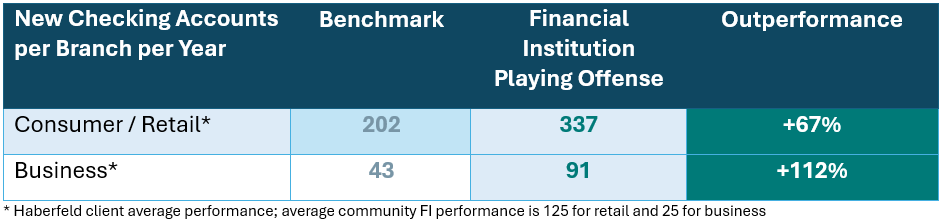
Consistently executing has compounded into a much larger and more productive portfolio. By 2025, the institution served almost 3,000 checking accounts per branch—twice the U.S. average of 1,500. That scale reflects the cumulative value of running the right plays, measuring results, and improving execution.
It also shows how better execution translates into stronger economics. The growth produced an annual economic advantage of more than $1 million per branch compared to peers.

The 2027 Offensive Game Plan
The 2027 mandate is clear: institutions cannot “technology” their way to core relationship growth or depend on occasional promotions while frontline capacity and accountability remain unresolved. They need a game plan and a disciplined sequence of plays.
In the first 45 days, leadership should define the objective by making checking growth an executive priority, identifying staffing gaps, protecting selling time, and establishing the opening baseline. In days 46–90, the team should implement the offense by building campaign audiences, training managers, restoring scorecard incentives, and launching weekly recognition. After day 90, leaders should coach execution by reviewing conversion by branch and campaign, pressing the advantage in opportunity markets, refreshing campaign audiences, coaching lagging teams, and scaling what works.
Winning teams do not abandon the plan after a difficult possession; they study results, make adjustments, and execute the next play. When leadership, people, marketing, and measurement move together, checking growth becomes a repeatable capability that produces durable core relationships and exceptional profitability while putting you at the top of the competition.